Companies that have made climate targets and net-zero commitments are under pressure to show measurable progress in reducing emissions across the supply chain. Understanding the impact of indirect emissions outside of their direct operations, known as Scope 3 emissions, is the biggest challenge. Solidaridad is testing a new model from the Cool Farm Platform to streamline the process to drive meaningful climate action.
Introducing the Soil Organic Carbon Model (SOC) Created for Perennial Systems
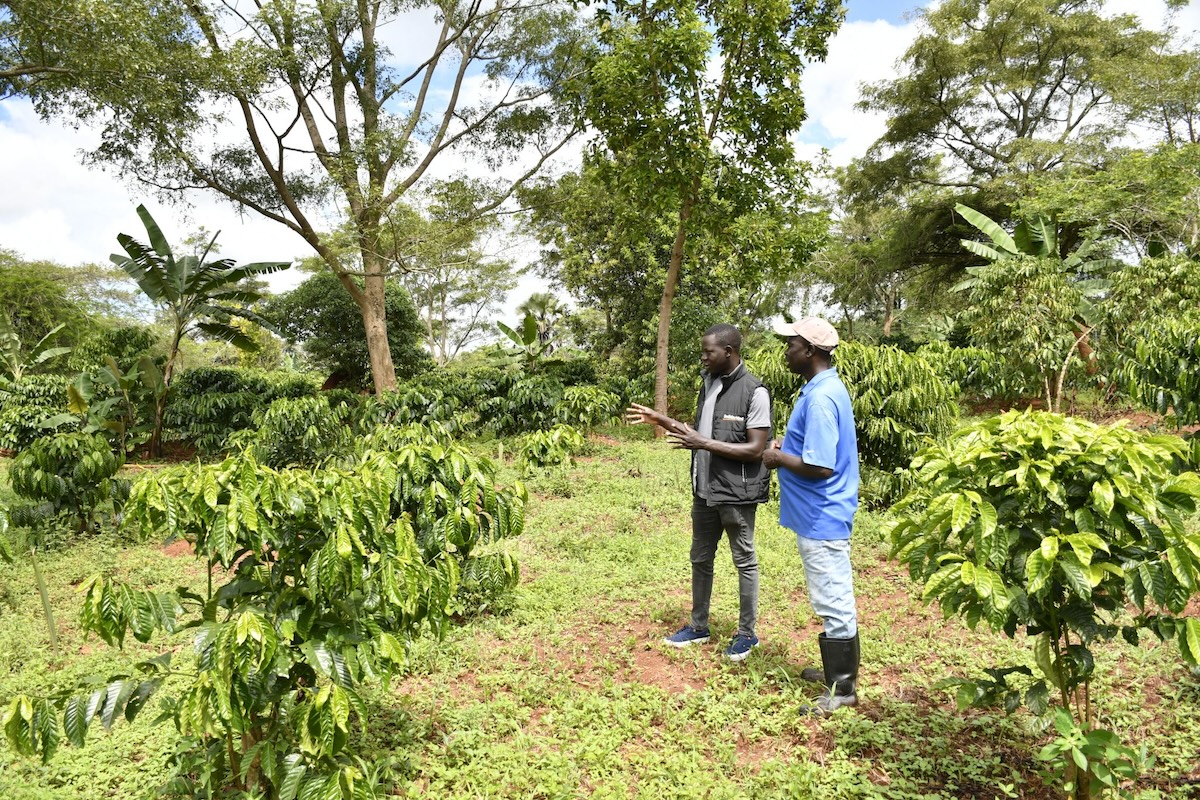
Measuring soil carbon is complex, especially in perennial systems like coffee, cocoa or nuts, in which roots, leaf litter and ground cover build organic matter over time. Existing models were mainly developed for annual crops, and are therefore unable to reflect the carbon content of perennial crops with permanent soil cover and complex plant growth.
Solidaridad recently tested the new Soil Organic Carbon (SOC) model within the Perennial Pathway on the new Cool Farm Platform, to explore how digital solutions can help both businesses and farmers get a grip on Scope 3 emissions. The SOC model enables more accurate Scope 3 calculations for businesses and empowers farmers to access sustainability incentives and emission-reduction projects within supply chains, also known as insetting.
Most traditional models rely on averages, assuming, for example, that all farmland emits or stores the same amount of carbon each year. But in reality, soil carbon content is influenced by:
- Crop type (e.g. cocoa vs. banana trees)
- Crop management (e.g. compost, cover crops, residue use)
- Weather (using monthly satellite-based data)
In contrast, the SOC model simulates how carbon moves into and out of the soil in real-world scenarios, allowing the user greater flexibility in options. Developed through a science-driven process, it’s designed to be both accurate and user-friendly, especially for smallholder perennial systems.
Field-Tested in the Climate Heroes Programme
Solidaridad tested the SOC model in the Climate Heroes programme, working with smallholder coffee and cocoa farmers in East & Central Africa. Our teams supported the field testing, Solidaridad provided financial contributions to the model development and trained local teams. The staff helped farmers to collect, maintain and validate the required data, making MRV (Monitoring, Reporting, Verification) accessible and scalable for smallholders.
The goal of this work is to adapt the tool to local conditions – a crucial step in turning complex data into actionable strategies for both farms and organisations. To make this possible, our staff receive ongoing training in the use of the Cool Farm Platform – as seen here in Central America in May 2025.
“We knew that to meet the needs of both farmers and businesses, we had to move beyond static emission factors. The SOC model allows users to see the carbon impact of real management choices – and that’s powerful.” Emily Durrant-Munro, Project Lead, Cool Farm.
What It Means for Farmers
For farmers, especially smallholders growing cocoa and coffee, this is a game-changer. By accurately modeling carbon gains from improved practices, they can:
- Improve soil health, productivity and farm resilience
- Access sustainability premiums and climate finance
- Participate in carbon markets or insetting initiatives
Better soil carbon data empowers farmers by linking their day-to-day management decisions directly to measurable climate impact, such as adopting regenerative practices like using organic inputs.
Why This Matters for Companies with Scope 3 Emissions
Companies in agricultural supply chains, including traders and roasters, are under increasing pressure to report and reduce Scope 3 emissions as part of their climate commitments.
The SOC model helps by:
- Facilitating transparent carbon footprint tracking
- Improving GHG inventories with better representation of perennial systems
- Supporting insetting projects and investments in regenerative practices
- Providing data integrity with peer-reviewed science and uncertainty analysis
- Standardising metrics to meet regulations and market demands
This enhanced digital platform helps farmers and agribusinesses to make data-driven decisions for crops like coffee, while enabling traders and roasters to measure, monitor, and reduce emissions across their supply chains. Ultimately, this helps all actors to align directly with the demands of sustainable markets.
Beyond sharpening technical expertise in the region, this training cemented Solidaridad’s role as a trusted advisor in carbon footprint management, a critical resource for companies decarbonizing their supply chains and buyers decarbonizing their operations.
Next Steps: From Root to Reporting
Solidaridad integrates cutting-edge science, digital tools and grassroots experience to offer technological answers to current challenges. Using our global tools and local expertise will provide companies actionable and measurable results.
Through the SOC model, Solidaridad, Cool Farm and other sustainability-driven companies are able to collaborate more effectively and engage more directly with farmers. By fostering trusted partnerships with farming communities, Solidaridad supports on-the-ground implementation and fieldwork. The SOC model is now available to Cool Farm Members – and the wider public – as part of Cool Farm Platform 3.0.
It’s time to rethink agriculture – from root to reporting.
- Contact Martine Krabben at martine.krabben@solidaridadnetwork.org at Solidaridad to start a pilot project.
- Learn more about this partnership from Emily Durrant-Munro at emily@coolfarmtool.org.
- Get in-depth details about the model from Dr. Megan McKerchar at support@coolfarmtool.org.