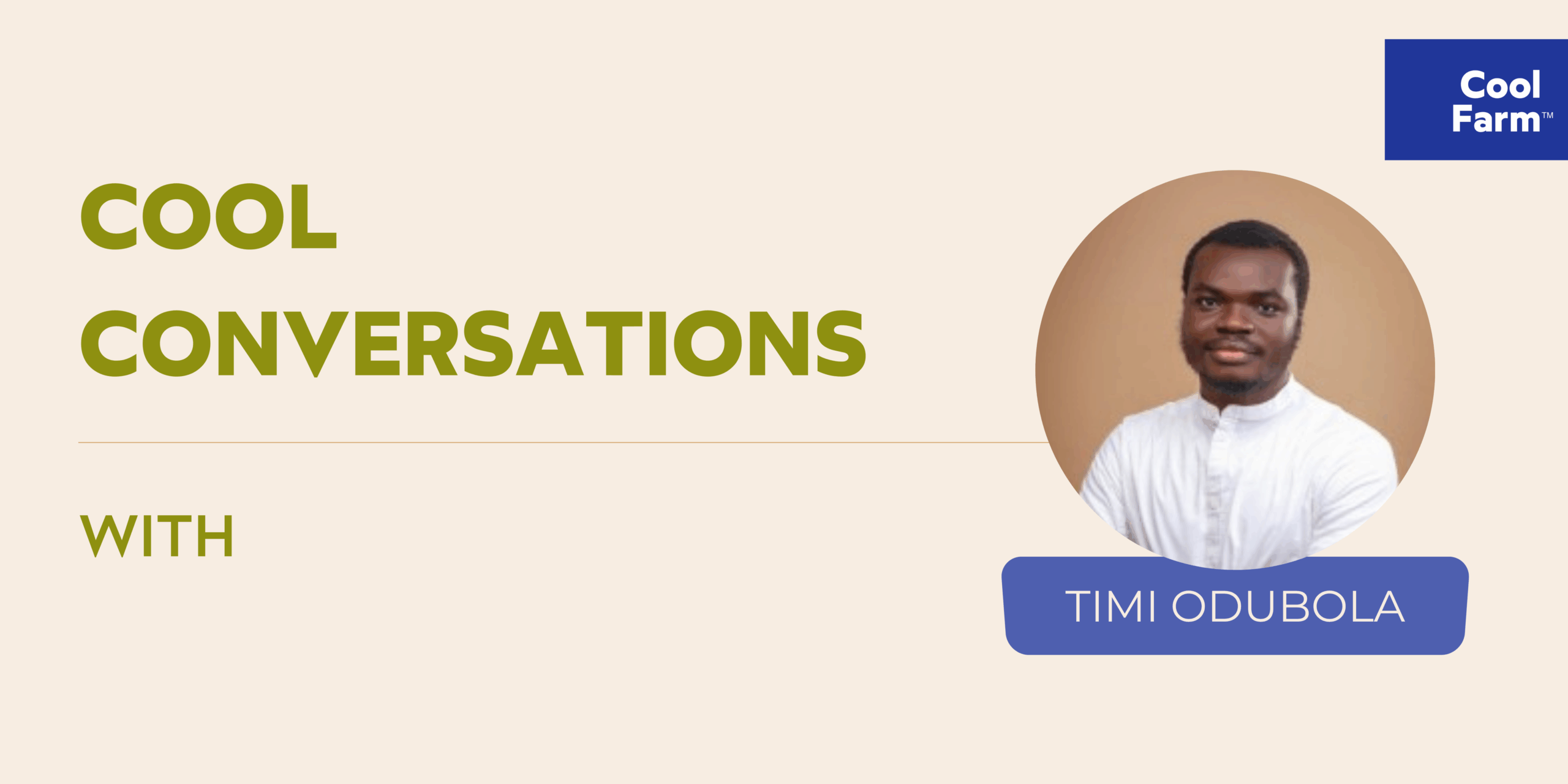
Welcome to the first edition of Cool Conversations, a new series where we spotlight the people behind Cool Farm – the engineers, scientists, brand and marketing, product managers and lots more!
In this series, we’ll dive into their roles, daily work, inspirations, and the ways they contribute to building tools that help farmers, supply chains, and sustainability teams measure and reduce environmental impacts. First up, we’re chatting with Timi Odubola, a software engineer whose work is helping make the Cool Farm Tool faster, smarter, and more accessible to users around the globe.
Hi Timi! Can you tell us a bit about yourself and your role?
Hi, I’m Timi Odubola, a software engineer at Cool Farm. My role centers on building, refining, and scaling the systems that power the Cool Farm Tool a platform used by farmers, supply chains, and sustainability teams worldwide to measure greenhouse gas emissions, biodiversity, and water impacts.
On a typical day, I might:
- Develop and optimise core components of the tool to make calculations faster and more reliable
- Work with scientists and method experts to translate complex climate and agricultural models into usable software features
- Enhance the user experience so that farmers and supply chain partners can interact with the tool more easily
- Ensure the platform integrates smoothly with partner systems, making data more accessible and actionable
- Contribute to testing, refining, and scaling new modules that reflect the latest science
No two days look the same, but the common thread is building systems that turn data and science into practical tools for global climate action.
What’s the biggest thing you’ve learned in your first year?
I’ve learned how important it is to balance scientific rigor with usability. A model can be mathematically sound, but if it isn’t accessible or practical for the people using it, farmers in the field, or sustainability leads managing supply chains it won’t have an impact. Building systems that are both robust and user-friendly has been a key lesson.
Has anything surprised you about working here?
Yes, the level of collaboration across disciplines. I work closely not just with other engineers, but with scientists and sustainability experts. I was surprised by how open the team is to co-creating solutions across these boundaries, and how much value comes from that exchange.
What project or piece of work are you most proud of from the past year?
One highlight was developing system optimisations for core calculations in the Cool Farm Tool. This work significantly improved speed and scalability, allowing more complex datasets and larger user groups to run assessments seamlessly. It was rewarding to see my contributions directly improve the experience for both farmers and supply chain partners.
I’m also proud of supporting integrations that allow organizations to connect their sustainability reporting systems with Cool Farm outputs — making it easier for global companies to track progress toward climate and biodiversity goals.
How has your role developed or changed since you started?
When I joined, I focused on smaller bug fixes and technical refinements. Over time, I’ve moved into designing new platform modules and leading feature development. I’ve grown into a role that bridges engineering and impact, ensuring the systems we build are scalable, accurate, and future-ready.
In what ways have you grown since joining?
- Technically: I’ve deepened my expertise in building scalable, resilient systems for scientific applications.
- Interdisciplinarity: I’ve learned to translate between engineering and science — taking complex models and making them work in real software.
- Leadership: I’ve become more confident in proposing technical solutions and guiding conversations on how to future-proof our systems.
What advice would you give to someone thinking of joining the team?
Be ready to embrace complexity and impact. You’ll be working on problems where the science is evolving, the stakes are high, and the users range from farmers in the field to multinational companies. If you’re curious, collaborative, and motivated by climate action, it’s an incredibly rewarding place to contribute your skills. You can always keep an eye on our latest jobs on Flexa Cool Farm | Verified Employers | Flexa Careers.
And finally, what do you love doing outside of work?
Outside of work, I have a strong passion for photography, which allows me to explore creativity from a different perspective. I enjoy traveling and discovering new environments, drawing inspiration from the diverse places and cultures I encounter and capturing them through my lens.
Want to meet more of the amazing people behind Cool Farm?
Stay tuned for the next edition of Cool Conversations, where we’ll share stories, insights, and inspirations from the team powering our mission to turn data into real-world climate impact.
Curious, inspired, or have questions for the team? Drop us a note — we’d love to hear from you!